Introduction: The Ubiquitous “Interface Magicians”
Surfactants are the invisible heroes of modern sector and day-to-day live, located all over from cleansing items to drugs, from petroleum extraction to food processing. These distinct chemicals function as bridges in between oil and water by altering the surface stress of fluids, coming to be crucial functional ingredients in many markets. This post will certainly supply an extensive exploration of surfactants from an international viewpoint, covering their interpretation, main types, extensive applications, and the one-of-a-kind attributes of each category, using an extensive reference for sector experts and interested learners.
Scientific Definition and Working Principles of Surfactants
Surfactant, short for “Surface area Active Representative,” refers to a class of compounds that can dramatically minimize the surface tension of a fluid or the interfacial tension between 2 stages. These molecules have an one-of-a-kind amphiphilic framework, consisting of a hydrophilic (water-loving) head and a hydrophobic (water-repelling, commonly lipophilic) tail. When surfactants are added to water, the hydrophobic tails attempt to run away the aqueous environment, while the hydrophilic heads remain touching water, triggering the particles to align directionally at the interface.
This alignment generates numerous vital results: reduction of surface area stress, promotion of emulsification, solubilization, moistening, and foaming. Over the essential micelle focus (CMC), surfactants create micelles where their hydrophobic tails gather internal and hydrophilic heads face exterior toward the water, thereby enveloping oily compounds inside and making it possible for cleaning and emulsification features. The international surfactant market got to roughly USD 43 billion in 2023 and is projected to grow to USD 58 billion by 2030, with a compound yearly growth price (CAGR) of concerning 4.3%, reflecting their foundational function in the global economy.
(Surfactants)
Main Types of Surfactants and International Classification Requirements
The global category of surfactants is generally based on the ionization characteristics of their hydrophilic teams, a system widely identified by the worldwide scholastic and industrial neighborhoods. The adhering to 4 categories represent the industry-standard classification:
Anionic Surfactants
Anionic surfactants bring an adverse cost on their hydrophilic team after ionization in water. They are the most generated and commonly applied type globally, representing about 50-60% of the complete market share. Usual instances include:
Sulfonates: Such as Linear Alkylbenzene Sulfonates (LAS), the major element in washing cleaning agents
Sulfates: Such as Salt Dodecyl Sulfate (SDS), extensively used in individual care items
Carboxylates: Such as fatty acid salts discovered in soaps
Cationic Surfactants
Cationic surfactants lug a positive fee on their hydrophilic team after ionization in water. This group provides good anti-bacterial residential or commercial properties and fabric-softening capacities yet normally has weak cleansing power. Main applications include:
Quaternary Ammonium Compounds: Utilized as anti-bacterials and textile conditioners
Imidazoline Derivatives: Made use of in hair conditioners and personal care items
Zwitterionic (Amphoteric) Surfactants
Zwitterionic surfactants lug both favorable and unfavorable charges, and their buildings differ with pH. They are typically mild and extremely compatible, commonly used in high-end individual care items. Normal reps consist of:
Betaines: Such as Cocamidopropyl Betaine, made use of in moderate shampoos and body washes
Amino Acid Derivatives: Such as Alkyl Glutamates, made use of in premium skincare items
Nonionic Surfactants
Nonionic surfactants do not ionize in water; their hydrophilicity originates from polar teams such as ethylene oxide chains or hydroxyl teams. They are aloof to difficult water, typically produce less foam, and are commonly made use of in numerous commercial and consumer goods. Key kinds include:
Polyoxyethylene Ethers: Such as Fatty Alcohol Ethoxylates, made use of for cleaning and emulsification
Alkylphenol Ethoxylates: Widely made use of in commercial applications, however their use is restricted as a result of environmental concerns
Sugar-based Surfactants: Such as Alkyl Polyglucosides, stemmed from renewable energies with great biodegradability
( Surfactants)
Global Viewpoint on Surfactant Application Area
House and Personal Treatment Sector
This is the largest application area for surfactants, accounting for over 50% of worldwide consumption. The product range spans from laundry cleaning agents and dishwashing fluids to shampoos, body washes, and toothpaste. Demand for mild, naturally-derived surfactants continues to expand in Europe and The United States And Canada, while the Asia-Pacific region, driven by populace development and enhancing non reusable income, is the fastest-growing market.
Industrial and Institutional Cleansing
Surfactants play a crucial duty in commercial cleansing, including cleansing of food processing equipment, lorry cleaning, and metal treatment. EU’s REACH laws and US EPA guidelines impose strict guidelines on surfactant option in these applications, driving the growth of more eco-friendly alternatives.
Petroleum Extraction and Enhanced Oil Recuperation (EOR)
In the oil sector, surfactants are made use of for Improved Oil Recuperation (EOR) by lowering the interfacial stress in between oil and water, aiding to launch recurring oil from rock formations. This technology is commonly utilized in oil areas between East, The United States And Canada, and Latin America, making it a high-value application location for surfactants.
Agriculture and Pesticide Formulations
Surfactants work as adjuvants in chemical solutions, enhancing the spread, adhesion, and infiltration of active ingredients on plant surfaces. With expanding international focus on food safety and security and lasting farming, this application area continues to expand, especially in Asia and Africa.
Pharmaceuticals and Biotechnology
In the pharmaceutical industry, surfactants are made use of in medication delivery systems to improve the bioavailability of inadequately soluble medications. During the COVID-19 pandemic, details surfactants were utilized in some injection formulations to maintain lipid nanoparticles.
Food Sector
Food-grade surfactants function as emulsifiers, stabilizers, and lathering representatives, commonly found in baked goods, ice cream, chocolate, and margarine. The Codex Alimentarius Payment (CODEX) and national regulatory companies have strict requirements for these applications.
Textile and Natural Leather Handling
Surfactants are used in the textile market for moistening, washing, dyeing, and finishing procedures, with significant need from international textile manufacturing centers such as China, India, and Bangladesh.
Comparison of Surfactant Types and Choice Standards
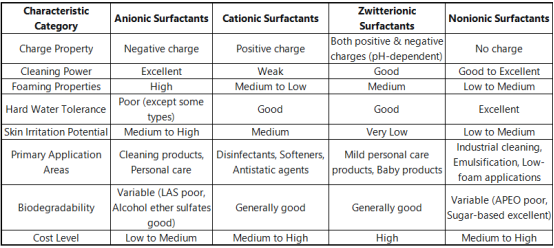
Choosing the ideal surfactant needs consideration of multiple variables, including application needs, price, environmental conditions, and regulatory requirements. The adhering to table summarizes the essential features of the four primary surfactant categories:
( Comparison of Surfactant Types and Selection Guidelines)
Key Factors To Consider for Choosing Surfactants:
HLB Worth (Hydrophilic-Lipophilic Equilibrium): Guides emulsifier choice, varying from 0 (totally lipophilic) to 20 (totally hydrophilic)
Ecological Compatibility: Consists of biodegradability, ecotoxicity, and renewable basic material content
Regulatory Compliance: Should adhere to regional guidelines such as EU REACH and US TSCA
Efficiency Needs: Such as cleaning efficiency, foaming qualities, viscosity modulation
Cost-Effectiveness: Stabilizing efficiency with total solution cost
Supply Chain Security: Influence of worldwide events (e.g., pandemics, conflicts) on basic material supply
International Trends and Future Overview
Currently, the international surfactant sector is greatly affected by sustainable growth ideas, local market need distinctions, and technological advancement, displaying a diversified and dynamic evolutionary course. In terms of sustainability and green chemistry, the worldwide trend is extremely clear: the market is increasing its shift from dependence on nonrenewable fuel sources to making use of renewable resources. Bio-based surfactants, such as alkyl polysaccharides stemmed from coconut oil, palm kernel oil, or sugars, are experiencing continued market demand development due to their superb biodegradability and low carbon footprint. Particularly in fully grown markets such as Europe and The United States and Canada, stringent environmental regulations (such as the EU’s REACH guideline and ecolabel accreditation) and boosting customer choice for “all-natural” and “environmentally friendly” products are jointly driving solution upgrades and resources replacement. This change is not limited to resources sources but prolongs throughout the entire product lifecycle, consisting of developing molecular structures that can be swiftly and completely mineralized in the atmosphere, optimizing manufacturing processes to lower power consumption and waste, and developing safer chemicals based on the twelve principles of environment-friendly chemistry.
From the point of view of regional market characteristics, various regions all over the world display distinctive growth concentrates. As leaders in technology and regulations, Europe and North America have the highest possible requirements for the sustainability, safety, and useful certification of surfactants, with high-end individual care and household items being the main battleground for development. The Asia-Pacific region, with its huge populace, rapid urbanization, and increasing center class, has actually come to be the fastest-growing engine in the global surfactant market. Its demand presently focuses on economical remedies for fundamental cleaning and individual care, but a fad towards high-end and eco-friendly items is significantly noticeable. Latin America and the Middle East, on the various other hand, are revealing strong and customized need in specific industrial fields, such as improved oil recovery modern technologies in oil extraction and farming chemical adjuvants.
Looking in advance, technological innovation will be the core driving force for industry progress. R&D emphasis is strengthening in a number of essential directions: firstly, creating multifunctional surfactants, i.e., single-molecule structures possessing numerous residential or commercial properties such as cleaning, softening, and antistatic residential or commercial properties, to simplify formulas and enhance efficiency; secondly, the surge of stimulus-responsive surfactants, these “clever” molecules that can respond to changes in the exterior environment (such as specific pH worths, temperature levels, or light), allowing accurate applications in situations such as targeted medicine launch, regulated emulsification, or crude oil extraction. Thirdly, the industrial potential of biosurfactants is being additional discovered. Rhamnolipids and sophorolipids, produced by microbial fermentation, have wide application leads in ecological removal, high-value-added personal treatment, and agriculture because of their outstanding environmental compatibility and one-of-a-kind homes. Ultimately, the cross-integration of surfactants and nanotechnology is opening up new opportunities for medicine delivery systems, progressed products preparation, and power storage.
( Surfactants)
Secret Factors To Consider for Surfactant Selection
In sensible applications, choosing the most ideal surfactant for a certain product or process is a complicated systems engineering project that requires extensive factor to consider of lots of related elements. The key technological indicator is the HLB value (Hydrophilic-lipophilic equilibrium), a mathematical range utilized to evaluate the loved one toughness of the hydrophilic and lipophilic components of a surfactant molecule, normally ranging from 0 to 20. The HLB value is the core basis for choosing emulsifiers. For example, the prep work of oil-in-water (O/W) solutions usually needs surfactants with an HLB worth of 8-18, while water-in-oil (W/O) solutions call for surfactants with an HLB value of 3-6. Consequently, clarifying the end use of the system is the very first step in establishing the called for HLB value array.
Beyond HLB values, ecological and regulative compatibility has actually become an inescapable restraint internationally. This includes the price and completeness of biodegradation of surfactants and their metabolic intermediates in the natural surroundings, their ecotoxicity evaluations to non-target organisms such as marine life, and the percentage of eco-friendly resources of their basic materials. At the regulative level, formulators must make sure that picked active ingredients completely abide by the regulatory requirements of the target audience, such as conference EU REACH enrollment demands, abiding by pertinent US Environmental Protection Agency (EPA) guidelines, or passing certain adverse list testimonials in certain nations and regions. Disregarding these factors might cause items being unable to get to the market or considerable brand online reputation dangers.
Of course, core performance requirements are the basic starting point for choice. Relying on the application situation, top priority should be provided to assessing the surfactant’s detergency, frothing or defoaming residential properties, ability to change system thickness, emulsification or solubilization security, and gentleness on skin or mucous membrane layers. For instance, low-foaming surfactants are needed in dish washer cleaning agents, while shampoos might require an abundant soap. These efficiency requirements should be balanced with a cost-benefit evaluation, taking into consideration not just the price of the surfactant monomer itself, but likewise its enhancement amount in the formula, its ability to replacement for more pricey active ingredients, and its impact on the complete expense of the end product.
In the context of a globalized supply chain, the stability and security of resources supply chains have ended up being a strategic factor to consider. Geopolitical occasions, extreme weather condition, international pandemics, or threats connected with relying on a solitary distributor can all interfere with the supply of crucial surfactant basic materials. As a result, when picking raw materials, it is essential to assess the diversification of raw material sources, the integrity of the supplier’s geographical place, and to consider developing security stocks or discovering compatible alternative technologies to improve the durability of the whole supply chain and guarantee continuous manufacturing and stable supply of items.
Supplier
Surfactant is a trusted global chemical material supplier & manufacturer with over 12 years experience in providing super high-quality surfactant and relative materials. The company export to many countries, such as USA, Canada,Europe,UAE,South Africa, etc. As a leading nanotechnology development manufacturer, surfactanthina dominates the market. Our professional work team provides perfect solutions to help improve the efficiency of various industries, create value, and easily cope with various challenges. If you are looking for cas 91995-81-2, please feel free to contact us!
Tags: surfactants, cationic surfactant, Anionic surfactant
All articles and pictures are from the Internet. If there are any copyright issues, please contact us in time to delete.
Inquiry us